Showing posts with label Space and Science. Show all posts

Tuesday, March 13, 2007

Saturn as a Heavenly Easter Egg

NASA explains the image :
This delightfully detailed false color image of Saturn is a combination of three images taken in January 1998 by the Hubble Space Telescope and shows the ringed planet in reflected infrared light. Different colors indicated varying heights and compositions of cloud layers generally thought to consist of ammonia ice crystals. The eye-catching rings cast a shadow on Saturn's upper hemisphere, while the bright stripe seen within the left portion of the shadow is infrared sunlight streaming through the large gap in the rings known as the Cassini Division.

Sunday, March 04, 2007

Answer to "Who Are They?"

Here's a more familiar picture of the men from the Who Are They? post. They are of course the seven Mercury astronauts looking lots better here in their shiny space suits!

In the Who Are They post from Thursday, February 22, 2007:

The seven original Mercury astronauts had participated in U.S. Air Force survival school at Stead Air Force Base in Nevada. Picture from left to right are L. Gordon Cooper, Jr., M. Scott Carpenter, John H. Glenn, Jr., Alan Shepard, Virgil I. Grissom, Walter M. Schirra, Jr., and Donald K. Slayton. Portions of their clothing had been fashioned from parachute material, and all had grown beards from their time in the wilderness. The purpose of this training was to prepare astronauts in the event of an emergency or faulty landing in a remote area.

Monday, February 05, 2007

Our Beach

This photo was taken at our beach on Australia Day 2007. Between the fireworks and the lightning is Comet McNaught. Click the image to see a larger view.

For full details of the photo and to see it full size, go here.

Saturday, February 03, 2007

Sad Loss of Engdangered Whooping Cranes

In addition to tragic loss of human life in those recent Florida storms, the entire whooping crane population from Operation Migration was lost. Those 18 birds represented the latest flock to be led from Wisconsin to Florida by ultralight. The flight is intended to teach the cranes a new migration pattern and to save the endangered birds.

Read about Operation Migration here. For some beautiful images of the flight, look on their website or google image search for "ultralight cranes". Also the wonderful movie Fly Away Home was based on the use of an ultralight to help migrating birds, in that case orphaned Canadian geese.

Thursday, January 18, 2007

Comet McNaught Visible

On Tuesday and Wednesday nights we had perfectly clear skies and Comet McNaught was spectacular. It was clearly visible from after sunset until after 9pm. The head and tail were very distinguishable. Hundreds of people came to our beach for a good look. For tonight it looks like the clouds have returned.

Tuesday, January 16, 2007

Comet McNaught

The weather didn't cooperate with our comet-watching last night. We waited patiently for the sun to set then looked in the proper direction and finally through a little peephole in the cloud cover, we saw Comet McNaught. We'll try again tonight. The sky is clear tonight but the comet will supposedly be less visible. There's a great photo gallery at Spaceweather.com of the comet in different parts of the world. Our view sadly was not comparable to any of these great photos.

Wednesday, December 20, 2006

Happy Holidays to the ISS Crew

Want to send the ISS crew a Holiday greeting? You can do it here by choosing a postcard, writing a message, and sending your message to the crew.

Tuesday, December 19, 2006

Mirror, Mirror On the Mountain


Residents in the Italian alpine village of Viganella solved an ancient problem with the help of a giant mirror. The small town’s unique valley location causes them to experience near darkness all winter long, with neighboring cliffs blocking the sun during daylight hours. The lack of both sun and warmth has long exacted a toll on daily life in the village; some have even abandoned the village completely for warmer abodes.

An innovative local, Pierfranco Midali, found a solution to this problem using a 8 x 5 meter mirror that reflects the sun back to the shivering village. The computer-aided mirror follows the sun and provides up to eight hours of sun a day.

"Here it's very cold in the winter and residents, many of whom are elderly, used to stay inside all the time. Now people are enjoying sitting on the bench in the square and having a chat," said Maria Velona, who works at the townhall.

NASA Chief's Impressive Credentials

NASA Chief Michael Griffin has seven degrees: a bachelor's, five master's, and a PhD. In addition he's a certified flight instructor.

He received a bachelor's degree in Physics from Johns Hopkins University; a master's degree in aerospace science from Catholic University of America; a Ph.D. in aerospace engineering from the University of Maryland; a master's degree in electrical engineering from the University of Southern California; a master's degree in applied physics from Johns Hopkins University; a master's degree in business administration from Loyola College; and a master's degree in Civil Engineering from George Washington University. He is a certified flight instructor with instrument and multiengine ratings.

Michael Griffin began his duties as the 11th Administrator of the National Aeronautics and Space Administration on April 14, 2005. As Administrator, he leads the NASA team and manages its resources to advance the U.S. Vision for Space Exploration.

Friday, December 15, 2006

Discovery: Beginning Day Seven in Space

Exactly 6 days ago, Aussie and I were in front of the computer screen watching Discovery lift off the pad, lighting up the night sky. We've been to the Cape for a daytime launch and Aussie saw a nighttime launch, standing on the beach in Ft. Lauderdale about 200 miles from the Cape. It's quite chancy to catch a launch. Our first try ended in disappointment so we tried again the next year and after a delay of one day, we saw the shuttle lift-off. We weren't close in, but when they lit the candle under the shuttle, the ground shook and the sky roared. It was amazing to be there, but in truth you get a much better view from your TV set.

Tuesday, July 25, 2006

Atlantis is Next

The shuttle Atlantis has been moved into the massive Kennedy Space Center assembly building (pictured) where it will be attached to a fuel tank and twin booster rockets in preparation for launch next month. The flight marks NASA's return to assembly of the International Space Station following the 2003 Columbia accident.

"We need to shift from the return-to-flight mode back to a more operational assembly sequence where we're flying, hopefully, four to five times a year and completing the assembly fairly quickly," Atlantis commander Brent Jett said.

Atlantis will be hauling a second set of massive solar arrays which are needed to boost the station's power output for partner laboratory modules. A firm date for the launch will be set following a flight review that ends on August 16th. The lift-off of Atlantis and six astronauts from Cape Canaveral in Florida is targeted for August 27 or 28.

Monday, July 10, 2006

Heavenly Help

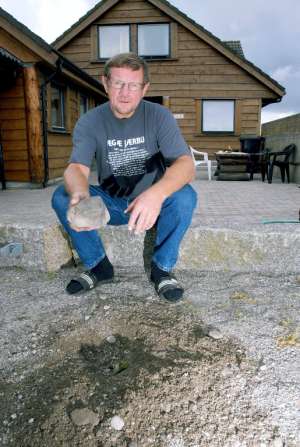
"We had just been wondering whether the cabin we're building is getting too expensive, and then this falls out of the sky," Bjørn Herigstad said with a laugh.

According to news from Norway in Aftenposten, a meteorite weighing around two kilos landed right in the yard outside Bjørn Herigstad's cabin in coastal Jæren, western Norway, over the weekend.

Herigstad isn't sure what he’ll do with the meteorite, which could be a valuable sales object. A quick check on the Internet revealed prices as high as NOK 700,000 (more than US$100,000).

Outback Australia Telescope

An innovative radio telescope made up of square tiles instead of conventional dish antennas will be built in outback Western Australia to study what switched on the first stars.

The Mileura Widefield Array, which will cover an area 1.5 kilometres in diameter, will use 500 six-metre square 'tiles' to gather radio signals from its site in the mid-west of the state.

The array will operate at low frequencies to 'see through' the neutral hydrogen, which is opaque to optical light, that filled the early universe.

Mileura Station (a livestock ranch) is roughly 300km inland from the western Australian coast, a few hundred km north of Perth ,and 350km from the small coastal city of Geraldton . The target region is extremely sparsely populated, and is characterized by fairly flat, sparsely vegetated, semi-arid terrain criss-crossed by shallow washes and watercourses.

Thursday, July 06, 2006

ISS/Discovery Passes

Since Discovery has docked with the International Space Station, it's a good time to check the almanac page at the Sky and Telescope site to see if there are any ISS/Discovery fly-overs in your skies. Simply put in your location (even the zip code will work in the US and Canada) and the almanac will give you the dates, times, duration, appearing and disappearing coordinates, and maximum elevation of the passes. The docking will continue until July 14th.

I don't know this for sure, but it seems that the passes could be brighter than usual. However, even if that is inaccurate, the ISS is the easiest object to spot in the clear night sky if you know where to look.

Here are our passes for tonight:
July 06, 9:22 pm 3 min.
July 06, 10:55pm 1 min.

In Progress: Discovery Docking with ISS

We are watching Discovery docking with the ISS on NASA channel. The live pictures are amazing. Here's a summary of the Discovery's mission from the NASA website:

Space Shuttle Discovery fired its engines just after 7 a.m. EDT beginning its final approach with the International Space Station. Discovery, which launched Tuesday afternoon to begin STS-121, is scheduled to dock with the station at 10:52 a.m. EDT today.

STS-121 will deliver supplies and equipment to the station. Much of the cargo is located in the Italian-built Leonardo multi-purpose logistics module. The STS-121 crew will also conduct at least two spacewalks while docked to the orbital outpost. During the excursions, the crew will demonstrate techniques for inspecting and protecting the shuttle’s thermal protection system.

Also, arriving with STS-121 is European Space Agency Astronaut Thomas Reiter. He will become Expedition 13’s third crew member. His arrival will return the station’s crew complement to three for the first time since Expedition 6 left in May 2003.

About two hours after Discovery arrives, the hatches will open and the STS-121 crew will enter the station for the first time. STS-121 is currently scheduled to depart the space station on July 14 and land in Florida on the 16th.

STS-121 will be the first shuttle mission to visit the station since STS-114 left in August 2005.

Wednesday, May 24, 2006

Chile Gets Latest Telescope

The 8.4m (28ft) Large Synoptic Survey Telescope (LSST), a telescope which will be 50 times as powerful as other survey telescopes, will be built on a mountain in Chile. It will join the existing Cerro Tololo Inter-American Observatory, on Cerro Pachon, an 2,640m (8,800ft) mountain peak in northern Chile. The telescope will scan the entire sky every three nights, and the observatory will be able to produce color movies of objects that change or move on rapid timescales. The decision to place the LSST on Cerro Pachon followed a two-year period of testing and analysis of the atmospheric conditions and quality of astronomical "seeing" at four sites in Chile, Mexico, and the Canary Islands. The LSST should be under construction by 2009 with a planned completion date in 2012.

Wallaby Milk to the Rescue

According to this article, researchers from the Victorian government's Department of Primary Industries have found that Tammar wallaby breast milk contains a highly-potent compound which is active against a wide variety of fungi and bacteria including antibiotic-resistant superbugs. The compound was found to be effective against a relative of the hospital superbug MRSA, or golden staph, as well as ecoli, Streptococci, Salmonella, Bacillus subtilus, Pseudomonas spp, Proteus vulgaris, and Staphylococcus aureus. The bacteria-fighting compound is deemed 100 times more effective than penicillin.

Friday, May 19, 2006

Discovery's Crawl

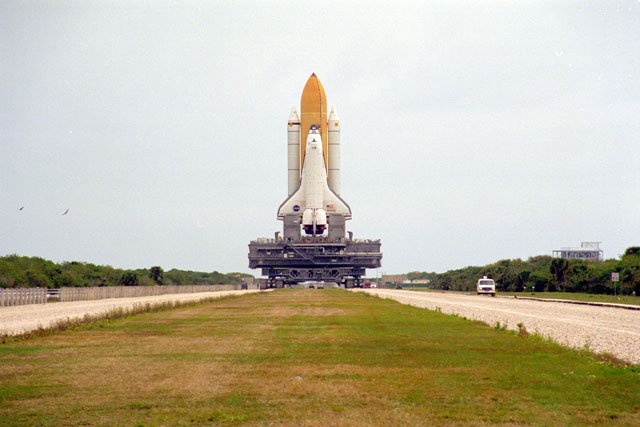
Space Shuttle Discovery's four-mile journey from the Vehicle Assembly Building to Launch Pad 39B is underway! The move brings NASA one step closer to the STS-121 mission, targeted for launch no earlier than July 1. Mounted on the Mobile Launcher Platform and carried by the mammoth Crawler-Transporter, Discovery emerged from the assembly building at 12:45 p.m. EDT. The "stack" rolls along at less than one mile an hour, and is expected to arrive at the launch pad sometime this evening. The STS-121 mission is targeted for launch no earlier than July 1.

Monday, May 15, 2006

Dragonfly Migration Revealed

Billions of common green darner dragonflies (Anax junius) migrate every year but until now hardly anything was known about their routes or strategy. New research into the migration behavior is available from a team of researchers from Princeton University. Detailed flight path information was made possible by tiny radio transmitters developed by the team. A transmitter weighing about a third of a gram was attached to green darner dragonfly's thorax with a couple of drops of superglue and some eye-lash adhesive. Then a team tracked the movements by following the signals from a receiving airplane.

According to this article in BBC Science, the dragonflies tended to only move after two nights of cooler temperatures, indicating a cold front was approaching with favourable north-westerly winds. They also tended to change direction when they met a large body of water, ensuring they never became stranded out over the sea. Two insects were recorded flying out over the ocean before reversing and skirting down the coastline. The data also revealed that the dragonflies' migration patterns are strikingly similar to those of songbirds, suggesting there is a strong evolutionary link to their behaviors.

Saturday, May 13, 2006

"Fairy" Penguin No More

Australia's fairy penguins have been renamed "little penguins" at Sea World theme park operators on the Gold Coast in Queensland to avoid offending the gay community.

Rebecca Smith, spokeswoman for Sea World, confirmed: "We didn't want to upset the gay community.We didn't have any complaints about the name of the penguins, but someone thought it could be seen as offensive so we decided to change it to little penguin instead.The name is more politically correct. We're not treating it as a big issue."

But the name change has had the opposite effect. Queensland's gay community described it as ridiculous and unnecessary.

"If they were called poofter penguins or something more direct, it might be a problem. But I don't see the name fairy penguin as a mickey take," Kamahl Fox, chairman of gay support group Gold Coast Breakers, said.